Yaroo: Making It Easier for Every Voice in the Room to Ask
I volunteer at ReDI School of Digital Integration Denmark, teaching web development. My students are smart, curious and full of good questions. But raising your hand in front of the whole room isn’t always easy - for anyone. You might be learning in your second or third language, you might be thinking “maybe everyone else already knows this”, or you might simply prefer not to have every head turn towards you. That’s not a student thing; it’s a human thing. I feel it myself at conferences.
The problem is that good questions then go unasked, and the whole class misses the chance to learn from them.
So I built a small tool to make asking easier: Yaroo.
What is Yaroo?
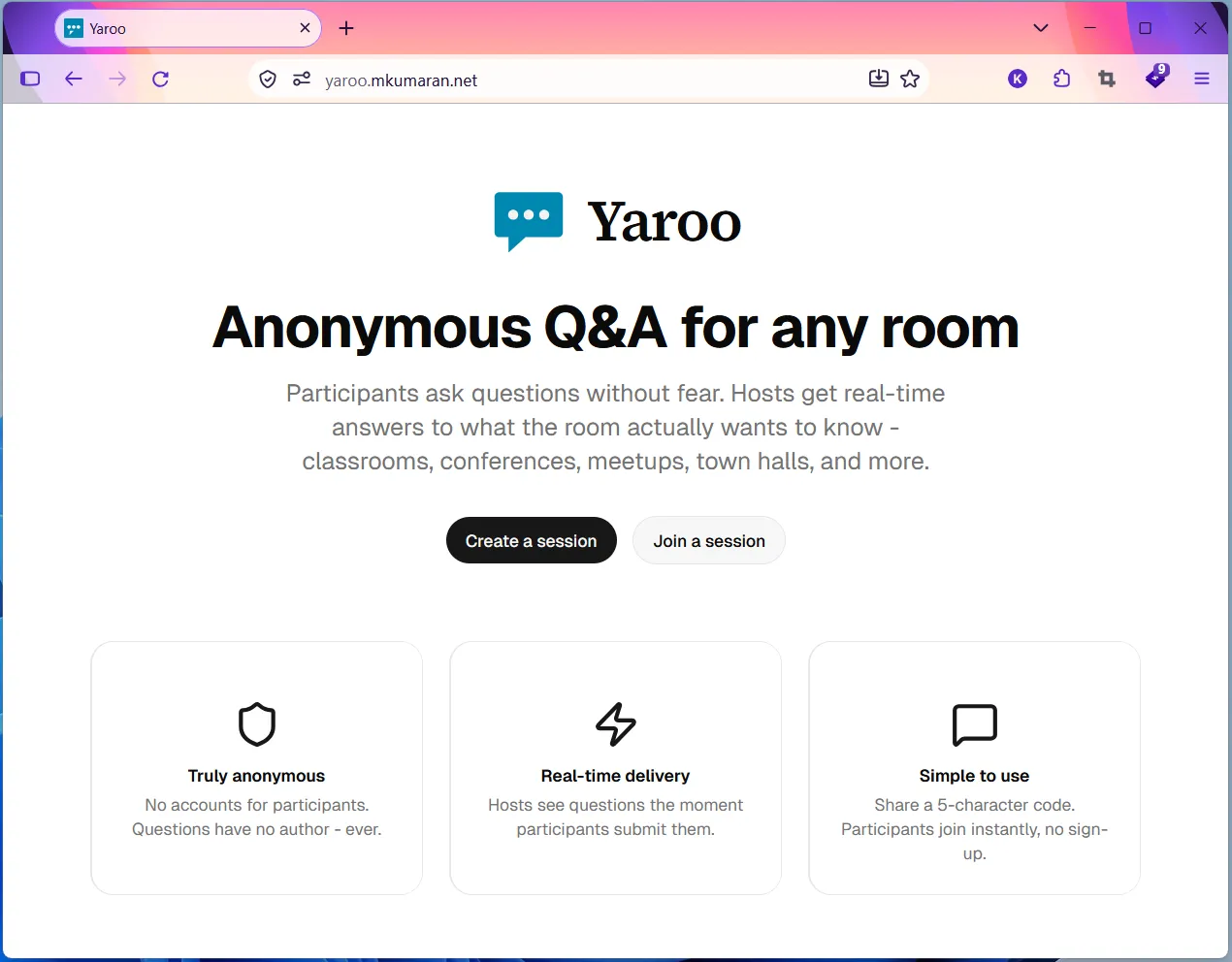
Yaroo is an anonymous, real-time Q&A platform. The host creates a session, shares a join code (or QR code) with the room, and participants ask questions without any sign-up and without their name attached.
The name is pronounced “yaa-row” and comes from the Tamil word யாரோ (yārō), which means “someone - we don’t know who”. That’s exactly the point: nobody knows who asked.
How it works
For the host
- Open yaroo.mkumaran.net and create a session.
- Show the join code or QR code on the projector.
- Watch questions arrive live on your screen.
- Delete questions that are off-topic, and close the session when you’re done.
- Export all questions (with their like counts) as a Markdown file, so you can follow up later or prepare the next class.
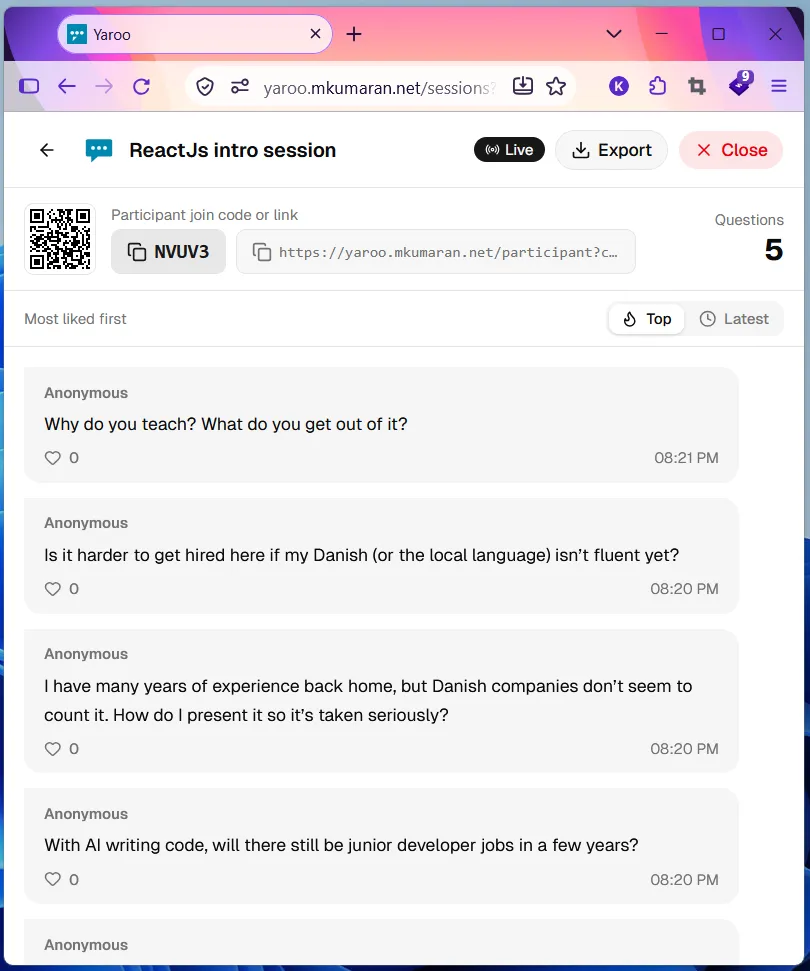
This is the host screen during a session. The QR code and join code are at the top, and every question arrives as “Anonymous”. Look at the questions: they aren’t about syntax or bugs. They’re about careers, language and the future of the job - the questions that matter most, and the ones that are hardest to ask with your hand in the air.
For participants
- Scan the QR code or enter the join code.
- Type a question and send it. That’s all.
- See everyone else’s questions and like the ones you also want answered.
Questions can be sorted by Top (most liked first) or Latest. With Top, the questions that most of the room cares about naturally rise to the top, so the host knows what to answer first.
Anonymous by design
Lots of tools say “anonymous” but still store who you are somewhere in the database. Yaroo doesn’t. There is no login, no user account, no device ID - a question is just text and a timestamp.
Even likes are anonymous. The server only keeps a counter for each question. To remember which questions you liked (so you can un-like), your own browser keeps that list locally. The trade-off is that someone could clear their browser data and like a question again - I accepted that, because protecting anonymity is more important than a perfect like count.
Not only for classrooms
I built it for my class, but it works in any room where speaking up in front of everyone isn’t the easiest way to ask:
- Conferences and meetups - collect questions during a talk and answer the most liked ones at the end.
- Team all-hands and town halls - let people ask the uncomfortable questions honestly.
- Workshops and trainings - gather feedback while the session is still going.
- Events - quick, honest feedback from the audience without any form to fill.
A little bit of tech
Yaroo is a React frontend with a Go backend and a SQLite database. New questions and likes appear on everyone’s screen instantly using Server-Sent Events (SSE) - no page refresh needed.
The whole app - frontend and backend - is packaged as a single Go binary inside a small Docker image, which makes it really easy to deploy. I’ve written about that setup in detail in Shipping a React + Go App as a Single Binary.
Try it
Next time you’re teaching, speaking, or running a meeting, give it a try: yaroo.mkumaran.net.
Often the question one person is holding back is the same one half the room is thinking. Yaroo just makes it easy to ask.